



I’ve written six dispatches about a pattern I keep running into. It started as an observation about GTM engineers. It generalized into a thesis about how companies encode their thinking. It became a purchasing argument, BYOI. Then a first-person report on what actually happens when you build one of these things. The last dispatch looked at the infrastructure underneath.
This one zooms out.
What I keep noticing, and what I think matters most now, is that this isn’t a speculative pattern anymore. It’s a convergence. Independent builders with no coordination are landing on the same thing, calling it by different names, building it in different stacks, arriving at the same architecture.
I first saw it in the GTME world, where I live. Jordan Crawford and Eric Nowoslawski have been building these systems in public for almost a year, focused on the GTM function specifically: pipelines, outreach, signal routing, the way sales teams encode institutional memory. That’s where the pattern first named itself clearly, and then I started seeing it everywhere else.
Garry Tan, President and CEO of Y Combinator, published an opinionated 26-skill “GStack” in April, plus a knowledge graph companion called GBrain built on a markdown wiki. Skills acting as CEO, UX designer, visual designer, engineer, QA, release engineer. Published, versioned, and still improving. A GTM-specific cortex became an everything cortex.
The list runs long and gets longer every week. Shills, non-technical founder of WE Way Labs, shipped a 17-module open-source operating system for his company with 30+ agents behind it. “I went from prompting an AI to employing one,” he wrote. Bary Huang put open-source code he calls Company OS on GitHub last month: “I built a startup operating system that runs my company, all with three AI engineers that used to be three engineer teams. Every conversation flows into a knowledge graph.” Ben van Sprundel, a Dutch agency builder: “Running a bigger team? A full business OS is the natural next step. But even that works best when each person has built their own context layer first.” Stephen Whitworth, CEO of incident.io, calls his personal system in Claude Code his “mini coach+chief of staff.” Riley Beresini came out of Disney Parks and Macy’s marketing with zero code background and wrote up his “compounding AI operating system” in February. Navruz Avloni is a California employment litigator who uses AI as her “thinking partner at work and at home.” Muratcan Koylan ships his as a Personal OS, file-based, living inside a Git repository.
I could keep going.
And it’s not just individuals. Tobi Lütke sent Shopify a memo making reflexive AI usage a baseline expectation, requiring teams to model what their function would look like with autonomous AI agents as existing team members before requesting headcount. Sebastian Siemiatkowski at Klarna cut their internal tool stack from around 1,500 SaaS products to a handful of agentic systems, calls the new setup “to some degree the operating system of the company,” says publicly that systems of record are dead in an agentic world. Patrick Collison at Stripe built a “fix it” button into the bug tracker that spins up autonomous dev environments Stripe calls “minions.” Wade Foster at Zapier runs his own stack of agents over meeting transcripts, culture analysis, interview evaluation, talent sourcing, and has taken the company to 89 to 97 percent internal AI adoption with a dedicated AI Transformation Officer.
The pattern is not scale-dependent. It’s running at every scale, from founder-of-one through multi-billion-dollar unicorn, all at the same time. The builders aren’t coordinating with each other. They’re arriving.
And because the pattern is arriving, startups are trying to sell it. Manus positioned itself as the first true “AI employee” and crossed $100M ARR in eight months before Meta acquired it. Paperclip shipped an open-source “AI Company OS” that went viral on GitHub this month. Lindy positions itself as autonomous AI operations. Rebolt ships through Y Combinator as an “AI-Powered Company OS.” Whether any of them are building the right thing is a question I’ll come back to.
At HHG my brother and I run two ventures on one of these systems. The Cortex is how we actually operate. It holds our voice, our customer relationships, the way we think through decisions, the process nobody wrote down. It’s bonded to the tools we picked and to the company we are. It’s not a product. It couldn’t be. It’s how we think, externalized.
The noun is forming too. Bary Huang calls his Company OS. Paperclip ships an AI Company OS. Rebolt, AI-Powered Company OS. Shills, WE Way Labs OS. Muratcan, Personal OS. I’ve been calling the shape CompanyOS across these dispatches. So has almost everyone else building one.
That’s the convergence. Once you see it, the interesting question stops being whether this is happening. It becomes what the landscape looks like when it’s done happening.
Call it CompanyOS. The cortex I’ve described across six pieces is its heart. Everything around the cortex is what this piece is about.

CompanyOS is the thing every company is becoming, whether they planned to or not. The cortex is its heart. Everything else is structure.
Start with the cortex. I’ve described it across the series as an intelligence layer encoding institutional knowledge. That was true but incomplete. Reading the convergence evidence back, the cortex does something more than encode. It coordinates. It acts.
The customer call ends, and the cortex doesn’t log a timestamp and hand you a blank email. It knows who the customer is, what was said last quarter, the tone of the last exchange. It has a read on which voice mode applies and where the account sits in the lifecycle. And it knows how important the account is to the company right now. It drafts the follow-up, files the notes, updates the CRM. Then it surfaces what needs to happen next. All of that happens because all of those systems are the same system. The cortex is the thing that makes them one.
When I look inside a real cortex, the kind I’ve been running at HHG, I see layers. Each layer has its own character. Each tends to live in its own place.
At the bottom is the architecture. The scaffold. Folder structure, database schema, command patterns, skill anatomy. This is the part that looks like code. It’s the part you can template, open-source, ship as a distro. Architecture is the most commoditized layer, and also the most visible, which is why the public conversation about building a cortex so often fixates on it.
On top of architecture sits the institutional knowledge. Voice, taste, relationships, customer stories, the way we decide things, the process nobody wrote down. It’s what makes a cortex yours and nobody else’s. You can’t buy this, and you can’t download it. It exists only because you encoded it. Every cortex has a version of this layer, and in every cortex it’s the place where the actual moat sits.
Then the operational files. Work artifacts. Briefs, drafts, handovers, research notes. Meeting summaries, campaign plans, the stuff you accumulate doing the work. These are the outputs of daily work and the inputs to tomorrow’s work. They sit close to the institutional knowledge and feed back into it over time.
Then the operational state. The live database. Pipeline stages, activities, warmth snapshots, task queues, open loops. State tells you what’s happening right now. Files hold what happened, when, and by whom. These two layers are conceptually close but technically different. State needs to be queryable at speed. Files need to be rich and readable.
Then the nerve paths. The agents. The skills. The coded behaviors that walk across the other layers and actually do things. This is the living part of the cortex. A nerve path reads institutional knowledge, consults operational state, pulls an operational file. It touches the relevant brick, writes a new file, updates the database. Then it sends the email and reports back. Nerve paths are the reason the cortex is an operating system and not a wiki. They’re also the reason you can’t buy a cortex as a product, because nerve paths are bonded to the specific bricks and content they navigate. A nerve path built for one company’s shape won’t work for another’s. I’ll come back to this. It’s the structural answer to why the productizing startups are fighting uphill.
On top of all this, once a cortex matures, it starts absorbing proprietary data. Transactions, customer records, contracts, communications, historical financials, HR files. The data every business generates and that most businesses currently keep in vendor systems. As the cortex grows, it pulls this data into reach, because context without it is partial. This is the layer that makes the cortex enterprise-grade or doesn’t. It also raises the biggest open question of the whole thesis: where does the container live?
And above that, at company scale, there’s a permissions and steward layer. Who reads what, who can write, who acts on whose behalf, who signs off, who audits what was done. This layer doesn’t matter when you’re running your own cortex solo. It becomes the whole game the moment a second human joins.
That’s the inside.
Around the cortex sit three kinds of things. There are the bricks, which are the apps. CRM, calendar, docs, messaging, analytics, finance tooling. The cortex reads and writes against them. Most of them exist already, built by today’s SaaS vendors. Post-cortex they’re infrastructure, not destinations.
There are the surfaces, which are the role-flavored windows humans use to interact with all of this. An account executive’s surface looks like a daily briefing and a pre-call intel pack, not a CRM dashboard. An accountant works out of a ledger view and an audit trail, not a generic spreadsheet. Surfaces collapse many bricks into one role-shaped view, composed at read time from the cortex underneath.

And there’s the substrate. The thing that hosts all of this. The place the cortex lives, the proprietary data sits, the nerve paths run, the audit log persists. I’ll get to this in a moment. It’s the biggest hole in the landscape.
That’s the shape of CompanyOS. Cortex at the heart. Bricks around it, surfaces on top, substrate underneath. Nothing about this requires prediction. Every part of it exists somewhere already. What’s changing is how they compose.
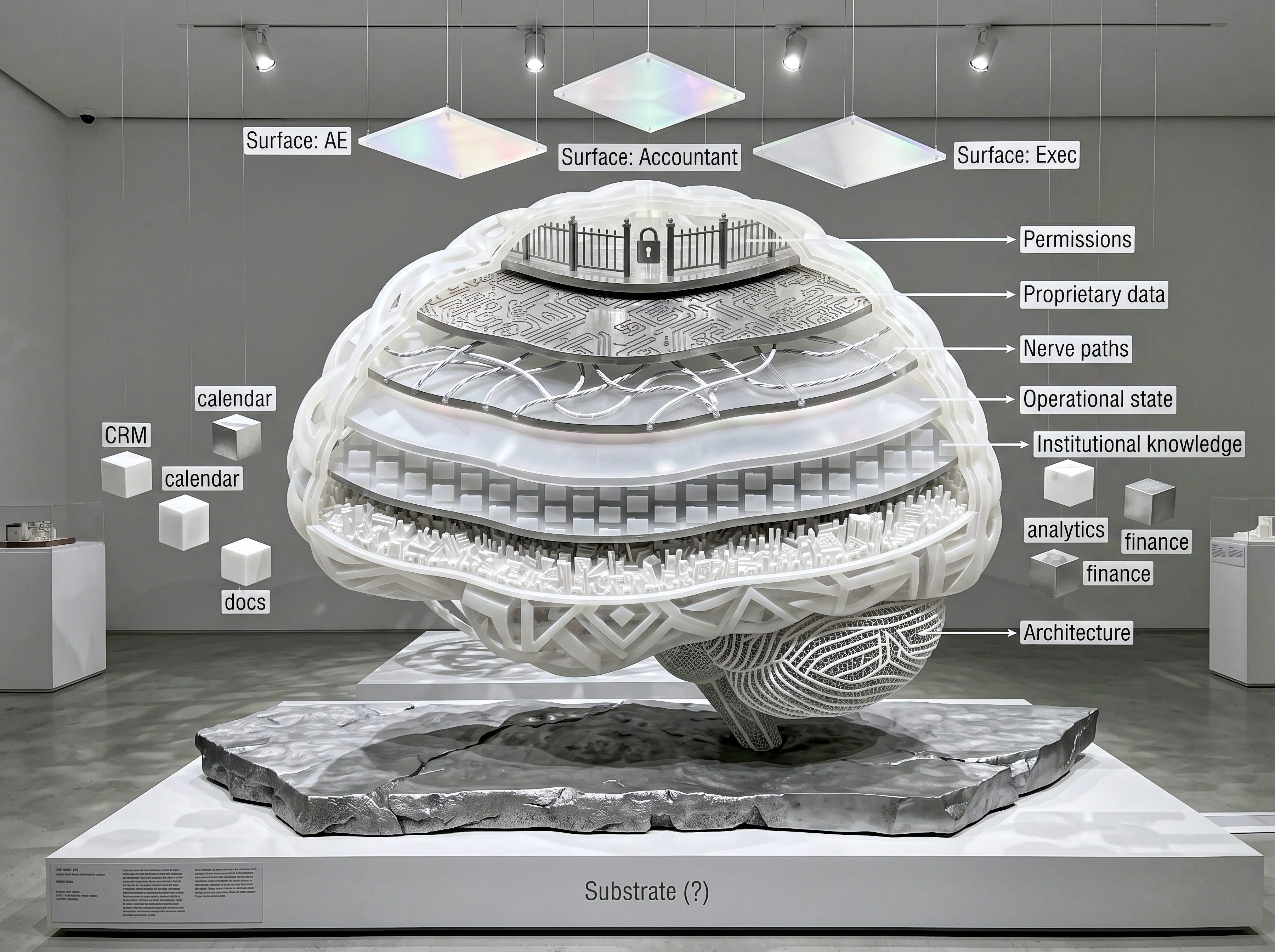
The landscape around CompanyOS isn’t mysterious. Most of it already exists. Some layers are obvious, others are still forming. One is missing entirely.
Start at the bottom. The iron, the compute that runs everything, doesn’t change. AWS, Google Cloud, Azure. The hyperscalers have kept their role through every major shift of the last twenty years, and no reason to think cortexes dislodge them. Cortexes will be heavy. They’ll run on the same clouds your Kubernetes cluster runs on. No news here.
Above iron sits the data substrate. This is where Databricks and Snowflake have been quietly building the most important company-critical infrastructure for a decade. Data lakes, data warehouses, vector stores. The shape they’ve built is “bring all your data to one place, we’ll let you query and analyze it from anywhere.” That shape is almost perfectly aligned with what a cortex needs. When the cortex matures and starts absorbing proprietary data, it’s going to ask a substrate “where do I put this,” and Databricks has a ready answer. Databricks has been positioning as the AI-native data platform for two years, and they’ve been ahead of everyone else on agent-accessibility. My bet is they’re the biggest structural beneficiary of this whole transition, more than any model provider.
Above data sits the model layer. Anthropic, OpenAI, Google, Mistral. You know this chart. The interesting question at this layer is whether any of them want to also own the layers above them. Anthropic has been moving that direction with Claude Code and its skills ecosystem, with Agent SDK and Managed Agents. OpenAI has been doing similar things on its own terms. Google has the data layer through Workspace but hasn’t turned that into a cortex story yet. Mistral is European and open-source-adjacent and interesting but still mostly model-only. Every model provider is currently asking itself a version of the same question: do we want to be the best model that powers other people’s cortexes, or do we want to own the substrate too? Those are two different companies. The answer isn’t clear from the outside.
Above the model layer sit the nerve path engines. The frameworks you use to actually build agents. Claude Code, MCP, Agent SDK, LangChain, OpenClaw, the Hermes agents. This layer is highly productizable, and also where the most intense competition is right now. It will probably commoditize within a couple of years. The interesting money isn’t in the engine itself but in what gets built on top of it. The engines are like programming languages: everyone argues about which is better, but the actual value gets built in the apps written in them.
Then the bricks. This is where today’s SaaS vendors live. Salesforce, HubSpot, Notion, Slack, Monday, Airtable, Linear, Attio, Gmail, Google Docs, Intercom, Stripe, QuickBooks, every vertical SaaS tool. All of these are bricks in the CompanyOS frame. Some of them know it. Most don’t. The ones who know are racing to expose clean APIs, agent-friendly auth, read-write endpoints that an external cortex can hit. The others are still competing on dashboards, brand, and workflow opinions that nobody’s cortex is going to honor. I’ll come back to what happens to them.
Above the bricks, in a tier that’s barely forming, are the distros: opinionated vertical cortex starter kits that bundle architecture, reference bricks, and pre-coded nerve paths into one artifact for a specific industry or role. This tier barely exists as a product category today. Salesforce’s vertical clouds come closest, as does Microsoft’s Power Platform template ecosystem, but both are incumbent-defense adaptations rather than native distros. I’ll come back to what a native distro looks like.
Next to distros sit the composers. Services businesses that build bespoke CompanyOSes end to end. This category is still forming. The native composer agency doesn’t exist yet at scale, but it’s the natural shape for the next wave of AI-native consultancies. Think of them as small architecture firms rather than big consulting houses. They’re opinionated and operator-run, selling the pattern they lived before they sold it. Composers are high-margin but don’t scale like platforms, because their work is bonded to each client’s specific setup. The best of them will ship their patterns as reference distros over time, which is how an agency turns into an IP business. This is where most of my income might come from in a year.
Alongside composers, there’s another kind of services business: the specialized software studio. Y Combinator has started naming this shape Agency as a Service, and it’s a good handle. These aren’t building full CompanyOSes. They’re building custom software for a targeted niche function, paired with deep domain expertise. Hedgineer.io is the working example. They ship complex custom financial models, dashboards, and analytics infrastructure for companies that need specialized financial tooling. Intelligence Matters, my brother’s agency, could evolve in this direction, shipping not just creative outputs but the custom software that generates them. Studios target a narrow function rather than the whole company. Their output often becomes a brick that plugs into the client’s cortex, rather than a CompanyOS the client runs on. The economics look similar to composers, high-margin and low-scale, but the scope is narrower and more defensible. YC funding this category is another signal the services layer of CompanyOS is being priced as a real business.
On top of everything sit the surfaces. Role-shaped windows. An AE’s surface isn’t a CRM dashboard, it’s a daily brief plus a pre-call intel pack plus a voice-coaching layer that listens to the call and debriefs after. That’s not a product Salesforce sells. It’s a new kind of product, and a lot of new surface companies are going to exist in the next five years. Calleoke is one. Others will emerge for operations, for accounting, for medical practice, for legal, for individual creators. The surface layer is where the consumer-friendly version of the cortex actually reaches non-builders. Most employees are never going to live in a terminal. They’re going to live in a surface that draws from a cortex they never see.
And then there’s the hole. The substrate. The thing that hosts a mature cortex. It stores the proprietary data, runs the nerve paths, persists the audit log. It federates across the bricks, enforces permissions at company scale, and meets compliance requirements for regulated industries. Nobody has shipped this. Databricks is closest on the data side, AWS on the iron side, GitHub on the file-hosting side. None of them have the whole thing. This is the biggest open commercial question in the post-SaaS landscape. I’ll get to it in its own section.
That’s the map. Bottom to top, with one open hole at the level where it matters most.
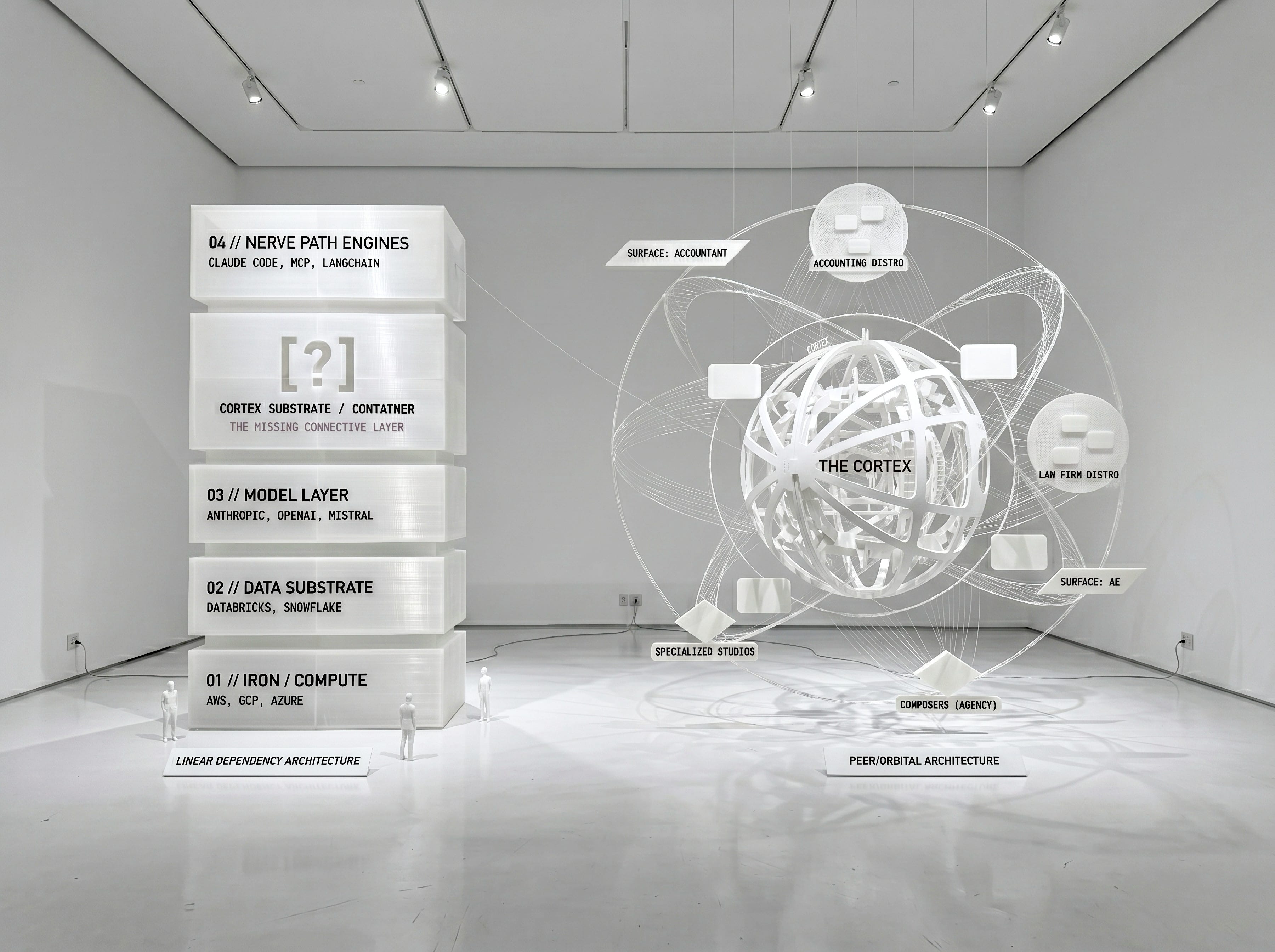
When I wrote BYOI, I argued that the edges go custom and the middle rents packaged SaaS. Enterprise builds because their intelligence is their competitive advantage. Founders build for a different reason, because their intelligence doesn’t exist yet and needs room to form. Middle-stage companies, I said, could rent “how to run sales” as a product because their processes were stable enough to fit a vendor’s template.
That was half right. The edges part holds. The middle part was too generous to the vendors.
What I missed is that the middle doesn’t need to rent anyone’s opinion. The middle needs to rent a framework. Those are different things.
A framework is architecture plus reference bricks plus pre-coded nerve paths, bundled as one artifact for a specific shape of company. Call it a distro. Mom-and-pop accounting distro, boutique law firm distro, fashion micro-brand distro, GTM team distro, SaaS startup distro, solo consultancy distro. You pick a distro that fits your shape, install it, and start adding your content from there.

The framework is opinionated. The content is yours. That’s the BYOI principle, scaled to the middle. You’re not renting someone else’s institutional memory. You’re renting a starter architecture they’ve already debugged, pre-wired with the kinds of bricks most companies in your shape already use, with nerve paths that know how to talk to those bricks out of the box.
The shops running this distro don’t have to become cortex operators overnight. They have to customize rather than construct. Most of the work is already done. The parts that matter stay theirs: voice, customers, process, relationships, judgment.
This is the prefab pattern, applied to operational infrastructure. Not every company needs to hire an architect. Most won’t, and most will buy a distro instead.
A distro isn’t just a software download. The companies shipping distros will invest heavily in onboarding flows, the first stretch where a customer’s content, bricks, and voice get wired into the framework. They’ll keep investing in continuous composer-like assistance afterward, because operational systems never sit still. The shape is closer to a SaaS company with a boutique services arm attached than to a pure product.
Distros don’t exist yet as a serious product category. Salesforce’s vertical clouds are the closest analogue, but they’re vendor-centric, not distro-centric. You’re still buying Salesforce’s opinion on sales, just getting a version of it pre-configured for manufacturing or healthcare. A real distro treats the bricks as swappable components. The opinion lives in the architecture and the nerve paths. The vendor relationship is incidental.
The companies that will build native distros are going to come from two places. Some will come out of domain expertise. A team that knows law firms better than anyone ships the law firm distro. Another team that’s spent ten years running fashion micro-brands builds the fashion one. They’ll have lived the opinion before selling it. A SaaS vendor retrofitting their platform for a vertical can’t replicate that.
The others will come from composer agencies. The composers I described in the last section build bespoke CompanyOSes for clients. After building enough of them, patterns emerge. A composer that has built eight accounting CompanyOSes has a distro-worth of pattern sitting in their files. Extracting that into a shippable artifact is how a services business turns into a product business without abandoning the services.
Distros are also the answer to the most common objection I get to the BYOI thesis. People say not every company has an Axel or a Garry, not every company can build this. That’s true. The BYOI thesis doesn’t require every company to build its cortex from scratch. What it requires is that every company own the content. The distros let everyone else get the infrastructure without constructing it themselves.
Architects build custom. Most companies don’t have to, and shouldn’t. Both ends live in CompanyOS. The only mistake is to keep living in SaaS because you thought you had to pick between building and buying.
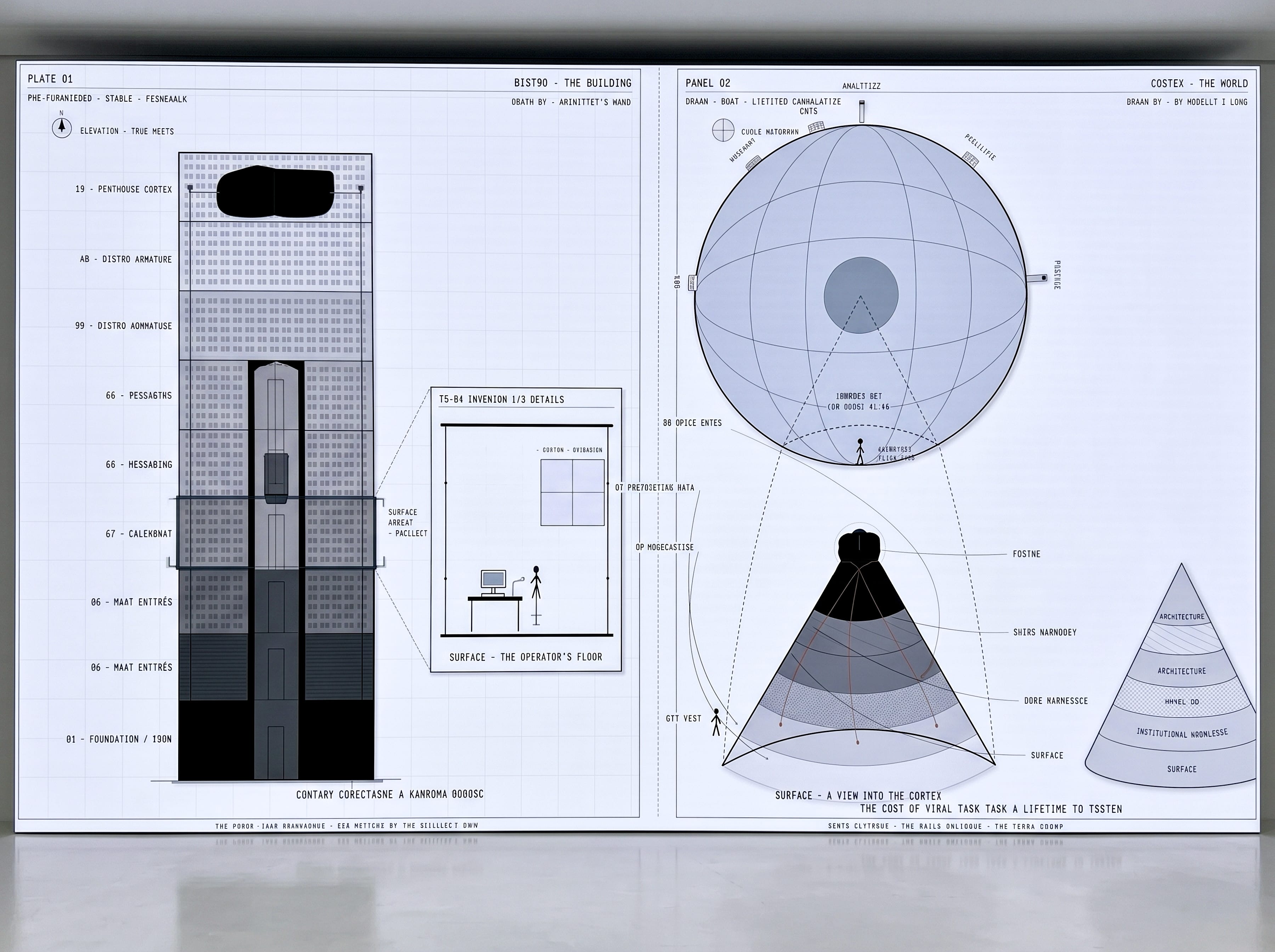
A young cortex is small. It lives in a git repo on your laptop, maybe a little VPS, a few folders, a database the size of a birthday present. Running it costs you cents. You can back it up to GitHub and call it infrastructure.
A mature cortex is not small. Once it starts absorbing proprietary data, the real data, the records and contracts and communications and historical financials, the substrate requirement changes. It has to be encrypted at rest and in transit. Access gets audited. Permissions run down to the field level. Compliance teams need to be able to prove what was accessed, when, by which agent, on whose behalf. Files are versioned. Nerve paths run sandboxed. And vendor lock-in becomes its own question, because a company betting its operations on a cortex doesn’t want its substrate provider to go bankrupt without an exit path.
That substrate doesn’t exist yet.
Pieces of it exist, scattered across companies that each own one layer. Databricks has the data side, probably the strongest position because their shape was built for exactly this problem. AWS sells the iron. GitHub handles file-hosting, versioning, collaboration, audit. 1Password and Vault cover secrets. Identity runs through Okta and Auth0. Datadog and Grafana handle observability. Security scanning shows up in tools like Snyk. None of them has the whole stack, and none has shipped “CompanyOS as a hosted substrate” as a product.
That’s the hole.
Four kinds of companies could fill it. The most obvious is an incumbent extending its footprint. Databricks is the natural candidate, given how close their existing shape already is. They could move from data substrate to cortex substrate without a full strategy pivot. Another route is a hyperscaler building top-down. AWS has the assets, though their history of building cortex-native products is uneven. Azure has the Microsoft enterprise relationships already in place. A third option is a model provider moving up the stack, which is what Anthropic might end up doing if they decide owning the substrate matters more than being the best model inside everyone else’s cortex. And there’s always the new-company option, built specifically for this shape, cortex-native from day one, in the way Vercel built for Next.js and Supabase built for application developers.
There’s a fifth track worth flagging. The whole discussion so far assumes a vendor sits somewhere. Open source and local models are on the table too, and they’re getting better fast. A regulated bank, a paranoid enterprise, or a government body with data it can’t let leave its own infrastructure can assemble a substrate out of open-source parts and run the whole thing on its own iron, with local models handling inference. The pieces already exist: Llama or Mistral weights for the models, open-source vector databases for the data side, self-hosted identity and audit stacks for governance. The open-source path doesn’t remove the need for a substrate. It just means the substrate gets assembled in-house rather than rented. For regulated industries especially, that will probably be the default.
My guess is it’s some combination. Databricks probably gets the biggest piece of the data layer. A new native company emerges for the file-and-nerve-path hosting, the GitHub-for-cortex story. Someone owns the permissions and audit layer, either a new company or an expansion from the current identity stack. Federation becomes the dominant model, with each layer running somewhere different and the cortex pulling them together.
Whatever shape it ends up taking, this is where the platform company of the decade gets built. Not from the model providers or the agent frameworks, and probably not from the app builders. It might come from a single vendor, or it might emerge as an open-source project that someone else builds a managed offering around. Either way, the thing that hosts the cortex in a shape companies can trust with their operations is what defines the next era of enterprise software. That company or project doesn’t exist yet. Somebody is going to build it.
This is the question the piece has been walking toward. The cortex is the asset. The substrate is the product. And the substrate isn’t here yet.

Three paths exist for an existing SaaS product once CompanyOS becomes the dominant shape. Become a brick. Become a library. Become nothing. There’s also a fourth move some incumbents are attempting, which I’ll come to.
Become a brick means accepting your new role as infrastructure. You expose clean APIs and agent-friendly auth. You stop competing on dashboards and start competing on data depth, endpoint reliability, and how well an external cortex can operate you. Some of your customers never log in again. Their cortex logs in for them. The ones who know this is coming will be fine. They were already moving this direction because the good ones read their own analytics and noticed human usage flattening while API usage climbed.
Not every brick is in the same position. There’s a whole class of SaaS that was never trying to be a daily-driver surface to begin with: Google Analytics, Meta Ads Manager, Stripe’s dashboard, Mixpanel, specialized compliance tooling, payroll systems, a hundred verticals I haven’t named. Nobody was fighting to spend more time in these tools. They’ve always been infrastructure in practice, and their moats sit in proprietary data, integrations, and connections that aren’t easily replicable. For them, becoming a brick is less of a demotion and more of a formalization of what they already were. Their fate depends on whether they play well with cortexes: clean APIs, agent-friendly auth, endpoints that an external system can operate and surface data from inside a CompanyOS. Some may prove impossible to brickify cleanly because of the depth of their proprietary infrastructure. You can’t vibecode a Google Analytics alternative from scratch. Your only option is hoping Google exposes it. And that’s fine. The CompanyOS doesn’t need to replace these tools, just operate them.
Become a library means getting absorbed into distros. You stop selling yourself directly and start getting packaged into other people’s frameworks. Your brand doesn’t disappear, but your customer relationship does. A fashion micro-brand distro picks your inventory module as one of its reference bricks. A law firm distro picks your document management module. You’re inside somebody else’s product now. The margins and unit economics are different. But you exist, and your codebase keeps shipping.
Become nothing means your product was never infrastructure to begin with. It was a dashboard or a workflow, someone else’s opinion about how your function should run, delivered through a UI that the cortex is never going to open. Nothing about your code was the moat. The moat was supposed to be the training investment, the workflow lock-in, the brand. The cortex doesn’t care about any of that. If your product’s value was mostly the interface and the opinions baked into it, your product has no second act.
Some incumbents are trying a fourth move: expand into a mini-CompanyOS. You add modules and bundle in neighboring functions, turning your single brick into a family of bricks under one brand. Slack has been doing this for a while, adding canvases, lightweight project management, docs. Notion stacks databases on top of pages on top of an AI layer. Airtable moves toward lightweight CompanyOS shape. Salesforce’s vertical clouds are the enterprise version of the same move. The bet is that customers will let you expand into a bigger part of their operational layer rather than replace you with native CompanyOS infrastructure. The risk is that the cortex pattern rewards open, file-based, portable systems, and every mini-CompanyOS move toward a walled garden fights that current. Some will survive the expansion. Most will end up as bigger versions of themselves that still don’t fit inside the substrate of the future.
Here’s the uncomfortable part. Most current SaaS products are in the “become nothing” category and don’t know it yet. They look at the cortex pattern and see it as a feature to add rather than a category to react to. They’re bolting AI onto dashboards nobody’s going to open, and launching co-pilots that do what their own customers are already doing in Claude Code without them.
Notion is interesting because they’re attempting the fourth move seriously. Databases, relations, pages, and an AI layer that connects them. The pieces are there. The shape is close. The problem is the walled garden. I moved my own cortex out of Notion because the best models had a hard time playing in their sandbox. They can describe Notion content, but they can’t operate on it the way a file-based cortex can be operated on. If Notion opens up far enough to become substrate, they have a chance. If they don’t, they become one of the most elegant bricks in the ecosystem. Either outcome is survivable, and better than most SaaS faces.
Airtable is similar. Lightweight CompanyOS vibes, walled-off execution. They know the cortex shape is coming. Whether they open up in time is the question.
Most of the rest of the ecosystem is harder to call kindly. Slack probably becomes a brick. Slack as a standalone dashboard product that companies pay $20 per user per month for is a tougher sell. The value was always the network, and the network migrates if the substrate asks it to.
And then the startups trying to sell CompanyOS back to the market. Manus, Paperclip, Lindy, Rebolt. I said earlier I’d come back to whether any of them are building the right thing. Here’s my read.
Manus and Paperclip and Rebolt are all betting that CompanyOS can be shipped as a pre-built generic product. Assemble the company structure, point it at your goals, their agents run it. Manus specifically positions itself as a ready-to-buy AI CEO, AI CMO, AI CFO you can plug into your company. That framing is the tell. The whole insight of the cortex pattern is that institutional knowledge cannot be shipped. Voice, judgment, relationships, the accumulated decisions of a specific company: these exist only because the company encoded them, over time, through use. I wrote about the compounding version of this in The Fractal Rabbit Hole. A cortex only becomes yours through slow accumulation of corrections, patterns, and learnings. Unpacking a box doesn’t get you there. A pre-built CompanyOS skips three things at once: the bond between nerve paths and your specific bricks, the institutional knowledge the cortex is supposed to encode, and the time that turns both of those into something real. It can do demo-shaped work, but not the real kind.
The path that works for companies in this space is either to pivot into the distro business, shipping opinionated frameworks for specific verticals instead of a generic everything-engine, or to pivot into services and become composers, building bespoke CompanyOSes for clients who need the outcomes but don’t want to assemble the infrastructure themselves. Lindy has already half-pivoted in this direction, repositioning from “AI employee” to practical workflow automation. That’s the correct move.
The rest are racing to productize a pattern that structurally resists productization. Some will find product-market fit by accident in narrow verticals. The rest will look back in two years and realize they were selling composer work at SaaS prices.

The efficiency story people tell about AI is usually about automation. Agents doing the whole job, employees being replaced, full end-to-end loops running without humans.
That’s not what CompanyOS actually does, and it’s not what any of the builders I cited are building.
The core principle of the cortex is what I’ve been calling HITM. Human in the middle. The cortex does the boring, time-consuming, context-intensive work of coordinating across systems, pulling history, drafting and filing, routing and scheduling, and briefing. The human stays in the loop for the parts that actually require a person: judgment, taste, relationships, the decisions that carry consequences. The cortex strips the toil out of every workflow and hands the interesting part back to the operator.
You don’t need full end-to-end automation to break SaaS. What breaks it is stripping enough of the boring parts that the operator’s hour of work no longer looks like the last generation’s hour. A GTM operator with a cortex handles forty accounts the way they used to handle ten. The cortex isn’t making decisions for them. It’s doing the research, the drafting, the scheduling, the follow-up coordination, and the CRM hygiene. The operator makes the same number of judgment calls. They make them faster and with better context.
This is leverage, not replacement. It’s the same shift that happened when accountants got spreadsheets, lawyers got Westlaw, and designers got Figma. Senior pattern recognition becomes portable through the tool. A junior operator with a well-tuned cortex starts to operate closer to the pattern-recognition level of a senior. The senior doesn’t become worthless. They become much more productive, because the grunt work that used to eat half their day gets delegated to something that doesn’t need a lunch break.
There’s a harder, honest point inside this. A meaningful share of office work today is rote coordination between systems that should have been talking to each other all along. The part of the job that was copying data between dashboards, chasing status updates, writing the same briefing for the fourth time, prepping the weekly report everyone skims: the cortex eats that work cleanly. People who were paid to do that work are in the harder position.
The efficiencies don’t stop there. The cortex also makes work that was previously expensive affordable. A boutique law firm that couldn’t justify a full-time ops person now runs lean because a cortex is doing the coordination. A solo consultant takes on work that used to need a four-person agency. Designers start shipping client-facing software along with the assets, because the cortex makes the software side tractable. The pie grows. Whether it grows faster than the old middle disappears is the question that determines whether the transition feels good or painful.
My honest read is that it feels painful first and good later, and that the good part is larger. Efficiency is deflationary, which is the same thing as wealth getting broader. Everything the cortex makes cheaper to do becomes affordable for more people. At the edge, that includes things we actually want more of in the world: practicing craft, shipping work that used to require a whole company, running a small business that operates like a big one. That last one is the part I find myself betting on personally.
There are three ways a company ends up inside CompanyOS.
The first is to build your own. Architect mode. This is for the companies with an Axel or a Garry on the inside, someone who thinks in systems, spends their weekends on folder structures and nerve paths, and treats the cortex as a product they’re shipping to themselves. Architect mode produces the most tailored cortex. It’s also the slowest and the most expensive in operator time. It fits a small number of companies well. Most aren’t going to pick it, and most don’t need to.
The second is to buy a pre-fab. Adopt a distro. Pick the one that fits your shape, plug in your content, let the framework handle the rest. The distro era isn’t fully here yet, but it’s the path most companies will end up on once the category matures. The pre-fab is not a worse choice than architect mode. It’s a different choice, closer to what most people pick when they buy a house. The custom design is beautiful and deeply yours. The pre-fab is reliable, supported, and gets you operational in weeks instead of quarters. Both live in CompanyOS. The ratio of one to the other will look like the ratio of architect-designed homes to developer-built homes in any city.
The third path is to go without. To keep operating on the SaaS stack, human-shaped dashboards, processes that live in people’s heads and scattered documents, and a model of running a company that worked for the last twenty years and won’t work for the next five. This path is going to look harder every year. The companies that stay on it will be outrun by the ones that didn’t. That’s not a prediction, it’s already happening in the companies I cited at the top of this piece.

At HHG we’re in architect mode across our ventures. The Cortex is bespoke because bespoke is the whole point of the level we operate at. Intelligence Matters will probably evolve toward studio work, shipping the custom software for creative production alongside the creative outputs, and maybe eventually into a fashion-micro-brand distro. Calleoke is a department-vertical cortex aimed at sales teams, one of the early surface companies I described. The composer work is where most of my attention goes.
The substrate piece is the thing I don’t know how to place yet. The container that all of this eventually runs on doesn’t exist, which is what the last few thousand words have been about. Whoever builds it gets the biggest commercial outcome of the decade. It might be one of the companies I already named. It might be a project none of us have heard of yet. The only thing I’m sure of is that the hole is there, and the market will fill it.
The cortex is real. The landscape around it is forming. The container is still open. That’s the bet.